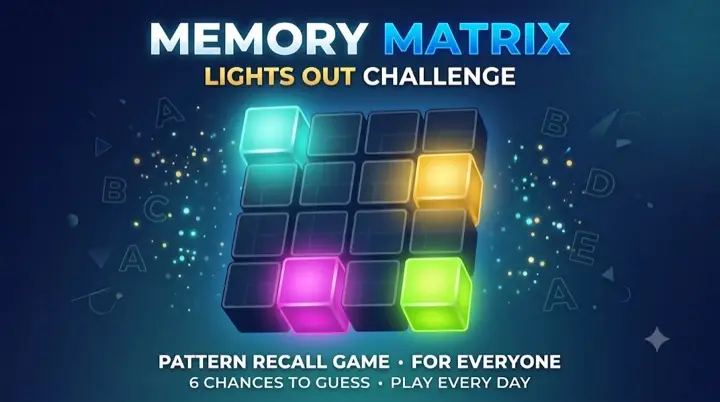
Weekly Heat
🏆 Memory Matrix Weekly Challenge
Push your best Memory Matrix score this week. Top runs appear below — beat them, favorite the game, and share your result with friends.
Resets each Monday · Official cups also run on Sudoku, 2048, Type Racer & Word Chain
📅 This Week’s Top Memory Matrix Scores
Live weekNo weekly scores yet for Memory Matrix.
Be first on the board — finish a run and your score can appear here.
TOP SCORES
Game Guide
Memory Matrix — Complete Guide
Learn how to play Memory Matrix on Arkade Game — grid recall rules, beginner tips, advanced memorization techniques, modes, and frequently asked questions.
About the Game
Memory Matrix strips memory training down to its purest form: watch a pattern, then reproduce it. A grid lights up a scattered set of cells for a brief window, the lights fade, and you tap to recreate exactly which cells were glowing a moment ago. There is no sequence to memorize, no story, and no complicated ruleset — just a direct test of how much visual information you can hold in your head at once.
That simplicity is precisely what makes the game replayable. Because the challenge scales cleanly with grid size and flash duration, Memory Matrix can serve a five-year-old in Kids Mode with a tiny 3x3 grid and generous viewing time, or push a seasoned player to their limit on a 7x7 Expert grid that flashes for barely a second. Nine distinct modes — Classic, Endless, Zen, Hardcore, Time Attack, Daily, Weekly, Kids, and Expert — let you pick exactly how much pressure you want in a given session.
Unlike sequence-recall games where remembering the order is half the battle, Memory Matrix rewards a different kind of memory: spatial chunking. Rather than memorizing nine individual coordinates one at a time, strong players learn to see lit cells as shapes — a diagonal line, an L, a small cluster in one corner — and recall the shape as a single unit instead of nine separate facts. That shift from counting cells to recognizing shapes is the single biggest skill jump in the entire game.
The progression systems give the format staying power beyond a few rounds. Coins and XP earned from clean rounds unlock new grid themes in the shop, while Daily and Weekly leaderboards use shared seeded patterns so your memory really is being measured against the same challenge everyone else faced. Power-ups like Hint, Replay, Extra Time, Freeze, and Cleanse offer a safety net for the toughest Expert rounds without making the base challenge feel like it needs a crutch.
How to Play
- Pick a mode from the hub — Classic is the standard starting point — and tap Play.
- Watch closely as a set of cells lights up on the grid for a short time.
- When the lights fade, tap the cells you remember being lit, in any order.
- Confirm your answer with Auto-check, or tap Check manually if you have that option enabled.
- Advance to the next round as the grid grows and the flash time shortens.
Controls
Memory Matrix is entirely tap-based on both desktop and mobile. Click or tap directly on grid cells to select them during the recall phase — there is no keyboard input required and no complex gesture system to learn. The same interaction works identically whether you are on a phone screen, tablet, or a desktop browser using a mouse.
Objective
The objective is to correctly recall as many lit cells as possible across increasingly difficult rounds. In Classic and Expert modes, the goal is to survive as many rounds as you can before running out of lives. In Endless and Zen modes, since mistakes carry no penalty or no life loss, the goal shifts purely to seeing how far your personal memory can stretch.
Beginner Tips
- Start in Classic or Kids Mode rather than jumping straight to Expert — the smaller grids build good habits faster.
- Resist the urge to count cells one by one; instead, try to see the overall shape they form.
- Use the Replay power-up sparingly at first so you get honest feedback on your natural recall ability.
- Turn off Auto-check in Settings if you find yourself second-guessing taps — reviewing before submitting can prevent careless errors.
- Play a few rounds of Zen mode to warm up your visual memory before attempting a scored run.
Advanced Strategies
- Group lit cells into recognizable shapes — letters, corners, small clusters — rather than memorizing raw coordinates.
- On larger grids, mentally split the board into quadrants and memorize each quadrant's pattern separately before combining them.
- Save Hint and Replay power-ups specifically for Expert-level rounds where flash time is shortest, rather than using them on easier early rounds.
- In Time Attack, prioritize speed of recall over perfect certainty — a fast, mostly correct answer often scores better than a slow, fully verified one.
- Practice Daily Challenge patterns repeatedly across the day if you replay them, since the same seed lets you refine your specific recall strategy for that exact layout.
Common Mistakes
- Trying to memorize every cell individually instead of recognizing shapes, which overloads short-term memory on larger grids.
- Spending all your power-ups early in a run instead of saving them for genuinely difficult rounds.
- Rushing the recall phase and tapping cells before fully committing the pattern to memory.
- Ignoring Kids Mode or Zen mode as "too easy" when they are actually useful warm-ups before harder sessions.
- Forgetting that order does not matter — hesitating over which cell to tap first wastes time for no benefit.
Winning Techniques
Consistent high scores come from treating each flash phase as a brief but focused observation window rather than a passive glance. Blink once, look away from distractions, and give the grid your full attention for the one or two seconds it is lit. Chunking cells into shapes rather than counting them individually is the single most reliable technique for extending how many cells you can accurately recall. On Expert grids, accepting that you might not remember every cell perfectly, and prioritizing the cells you are most confident about, tends to score better than freezing up trying to recall everything.
Mobile Tips
- Hold your phone steady during the flash phase — even small movements can distract from spotting every lit cell.
- Play in a bright, glare-free environment so dim or fast flashes remain clearly visible.
- Use fullscreen mode if available to maximize the visible grid area on smaller phone screens.
Keyboard Shortcuts
Memory Matrix does not require keyboard input for its core gameplay, since every interaction happens through direct taps or clicks on the grid. Some builds support Escape to pause a session, but no other keyboard shortcuts affect how you play.
Features
Memory Matrix includes nine distinct modes, a coin and XP economy, unlockable grid themes, achievement tracking, and Daily and Weekly leaderboards built on shared seeded patterns. A stable of power-ups — Hint, Replay, Extra Time, Freeze, and Cleanse — gives players extra tools for the toughest rounds without changing the fundamental memory challenge.
Game Modes
- Classic: standard rounds with lives and gradually increasing difficulty.
- Endless: no fixed end point, ideal for chasing a personal record.
- Zen: no penalty for mistakes, perfect for relaxed practice.
- Hardcore: faster flashes and less forgiving rules for experienced players.
- Time Attack, Daily, Weekly, Kids, and Expert: additional formats that vary pacing, shared seeding, and difficulty for every skill level.
Frequently Asked Questions
The most common questions cover how Memory Matrix differs from sequence-based games like Simon Memory, what grid sizes and Hardcore versus Classic difficulty actually change, and how the Daily Challenge's shared seed makes leaderboard comparisons fair. Full answers above also cover Kids Mode, Auto-check, and the most common reason players lose a life on an easy-looking round.
Final Thoughts
Memory Matrix is proof that a genuinely useful brain-training exercise does not need a complicated ruleset to be engaging. The core loop of watching, remembering, and recreating a pattern scales smoothly from a gentle Kids Mode session to a punishing Expert grid, giving every player a natural difficulty curve to climb. Start small, focus on recognizing shapes instead of counting cells, and let the Daily Challenge turn a quick memory test into a habit worth returning to.
Explore more in all free online games or jump to Simon Memory, Sudoku, Nonogram . Strategy write-ups also live on the Arkade Game blog.
🎮 Why You'll Love This Game
You’ll love Memory Matrix for holding patterns in your head and proving you still remember them. Memorize highlighted cells and reproduce the pattern — and Arkade Game keeps progress with XP, coins, and leaderboards so every short session still counts.
🧠 Skills You Improve
-
Logic 4/5
-
Memory 5/5
-
Speed 3/5
-
Strategy 3/5
-
Reflexes 2/5
📈 Difficulty Meter
Medium · Easy–Expert
⏱ Average Match Time
5–12 minutes
🔥 Trending Score
55/100
🆕 Last Updated
⭐ Best For
🏆 Community Challenges
- Complete today’s daily challenge for Memory Matrix and claim streak rewards.
- Beat today’s memory length or pattern level.
- Improve your best streak by one clean round.
📊 Player Statistics
- All-time plays
- 47
- Player rating
- No votes yet
- Top score
- 3,150
- Category
- brain
🎯 Related Games
More titles that pair well with Memory Matrix.

Guides & Blog Articles
Strategy deep-dives live in the Blog — not mixed into other site areas.
Best Quick Brain Games for Daily Training
Short brain games you can play in five to fifteen minutes daily — Sudoku, Memory Matrix, 2048, Wordle, and mor...
Read article →Brain Games for Adults: Stay Sharp with Daily Play
Discover the best brain games for adults — Sudoku, Chess, Memory Matrix, Wordle, and more — and build a daily...
Read article →