Weekly Heat
🏆 Nonogram Weekly Challenge
Push your best Nonogram score this week. Top runs appear below — beat them, favorite the game, and share your result with friends.
Resets each Monday · Official cups also run on Sudoku, 2048, Type Racer & Word Chain
📅 This Week’s Top Nonogram Scores
Live weekNo weekly scores yet for Nonogram.
Be first on the board — finish a run and your score can appear here.
TOP SCORES
Game Guide
Nonogram — Complete Guide
Learn how to play Nonogram (Picross) on Arkade Game — number clue rules, beginner tips, advanced solving techniques, grid sizes, and frequently asked questions.
About the Game
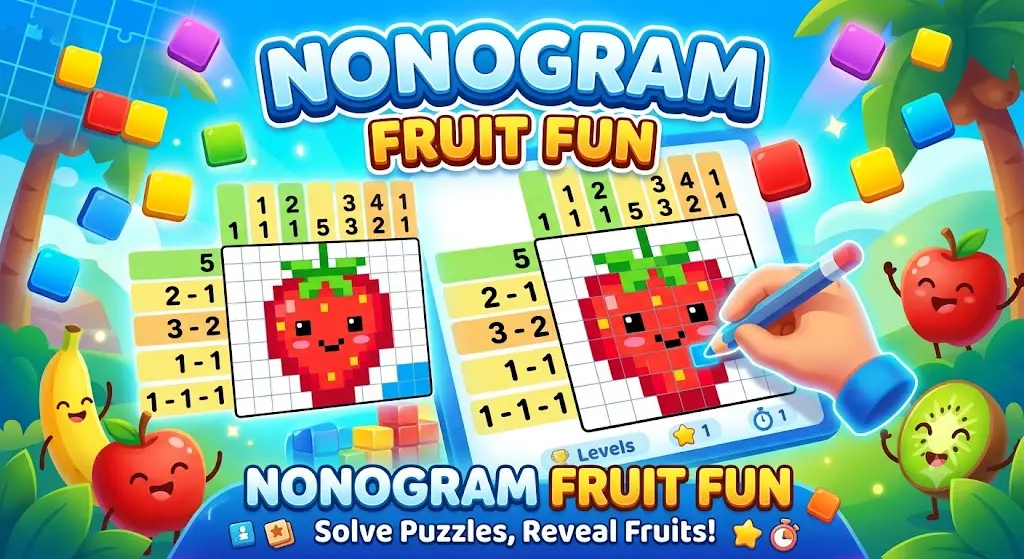
Nonogram, sometimes called Picross, turns a grid of blank cells into a hidden picture through pure number logic. Every row and column carries a set of numbers, and each number represents a consecutive run of filled cells somewhere along that line. There is no guessing required in a well-designed puzzle — every cell can eventually be determined through careful cross-referencing between its row and column clues, which is exactly what makes solving one feel so satisfying once the picture finally clicks into place.
The format scales beautifully. A 5x5 grid with simple clues makes an excellent introduction, often revealing a recognizable picture within a couple of minutes. A 25x25 Expert grid, on the other hand, can take genuine concentration and careful notation to work through, since a single overlooked deduction early on can cascade into confusion later. Twelve themed categories — spanning Animals, Anime, Sports, Cricket, IPL, Cars, Food, Nature, Geography, Flags, and Holidays — keep the picture reveals varied enough that solving never feels repetitive, whatever size grid you prefer.
What separates a good nonogram session from a frustrating one is technique. Beginners often try to fill cells based on a rough guess of what the picture might be, which works occasionally but falls apart on denser grids. Stronger solvers instead treat every row and column as an independent logic problem first, only using the emerging picture as a sanity check rather than a primary strategy. Learning to spot "forced" cells — positions that must be filled or empty no matter how the rest of the clue could be arranged — is the core skill that turns a slow, guess-heavy solve into a fast, confident one.
The daily and archived puzzles give the game a genuine rhythm. The Daily Nonogram uses one shared seed worldwide, so a clean solve puts you directly on the same leaderboard as everyone else who tackled the identical clues that day. Between the Daily Challenge, Unlimited random puzzles, and themed Classic grids, along with XP, coins, badges, and Global, USA, and India leaderboards, there is always a fresh picture waiting to be uncovered.
How to Play
- Open the hub and choose Daily Nonogram, Unlimited random puzzles, or a themed Classic grid.
- Pick a category and a grid size from 5x5 up to 25x25.
- Read the number clues beside each row and column — each number is a consecutive run of filled cells.
- Tap to fill a cell you are confident about, and long-press to mark a cell with an X that must stay empty.
- Continue cross-referencing rows and columns until the entire hidden picture is revealed.
Controls
Nonogram is primarily a tap-based game. Tapping a cell fills it in as part of the picture, while a long-press marks it with an X to indicate it must remain empty. On desktop, a standard click performs the fill action, with a secondary interaction, such as a right-click or dedicated mark tool, available for placing X marks. Auto Cross and hint buttons sit alongside the grid and require only a single tap or click to activate.
Objective
The objective is to correctly fill every cell that belongs to the hidden picture, using only the row and column number clues as your guide, without triggering incorrect fills where error detection is enabled. Completing a grid cleanly, especially without spending coins on hints or reveals, earns the strongest score and the best badge outcomes.
Beginner Tips
- Start with smaller 5x5 or 10x10 grids before attempting anything larger — the core logic is identical, just with fewer variables to track.
- Look first for rows or columns where only one arrangement of the clue numbers is physically possible, and fill those immediately.
- Mark cells you are certain are empty with an X as soon as you know it, rather than leaving them blank and re-checking later.
- Use Auto Cross early on busy grids so obviously empty cells are handled automatically, keeping your view cleaner.
- Pick a category you enjoy — recognizing the emerging picture can help confirm your logic is on the right track.
Advanced Strategies
- Solve any row or column with only one legal placement first, then use the newly confirmed cells to cascade deductions into the perpendicular clues.
- On large grids, work from the edges inward, since edge rows and columns often have fewer possible arrangements than the busy center.
- When two clue numbers are close to filling their full line, calculate the guaranteed overlap cells mathematically rather than filling by intuition.
- Save Smart Hint and Reveal tools for a single stuck cell rather than an entire row, preserving as much of your score multiplier as possible.
- After finishing a puzzle without hints, revisit a slightly larger grid size in the same category to keep building on what you just solved.
Common Mistakes
- Guessing a fill based on what the picture might look like instead of confirming it through clue logic.
- Skipping the X-marking step, which makes it easy to lose track of which cells have already been ruled out.
- Jumping straight to Expert-size grids before practicing the core deduction techniques on smaller ones.
- Overusing Reveal Row or Reveal Column, which significantly reduces your final score multiplier.
- Losing track of clue numbers on very large 25x25 grids by not using Auto Cross to keep the board readable.
Winning Techniques
Consistent nonogram solvers treat every row and column independently before looking at the picture as a whole. They hunt for forced cells first — spots that must be filled or empty regardless of how the remaining clue numbers could be arranged — and use those confirmed cells to unlock the next round of deductions in the perpendicular direction. On tougher grids, calculating overlap between the largest possible and smallest possible placement of a clue number, rather than guessing, is the technique that separates fast, clean solves from long, hint-heavy ones.
Mobile Tips
- Use a tablet rather than a small phone screen when attempting 20x20 or 25x25 grids, since clue numbers can become cramped on smaller displays.
- Take advantage of pinch-to-zoom if available to double-check clue numbers before committing to a fill.
- Long-press deliberately rather than quickly to avoid accidentally marking a cell you meant to fill, or vice versa.
Keyboard Shortcuts
Nonogram is primarily a touch and click experience, so no keyboard shortcuts are required for core play. Desktop users typically rely on mouse clicks for filling cells and a secondary click or toggle button for marking X cells.
Features
Nonogram includes twelve themed categories, five grid sizes from 5x5 to 25x25, Easy through Expert difficulty, auto-save, Smart Hint, Auto Cross, Reveal tools, a Puzzle Archive for replaying past dailies, XP, coins, achievement badges, and Global, USA, and India leaderboards.
Game Modes
- Daily Nonogram: one shared puzzle worldwide, refreshed each day.
- Unlimited: randomly generated puzzles for endless practice.
- Classic: themed, curated grids across all twelve categories and every grid size.
Frequently Asked Questions
Common questions cover available grid sizes, how the Daily Nonogram's shared seed works, and the difference between filling and marking a cell. Players also ask how helper tools like Auto Cross and Smart Hint function, whether hints reduce your final score, and what mistake most often stalls an otherwise solvable grid. The full answers above cover all of it, including the full list of puzzle categories.
Final Thoughts
Nonogram rewards exactly the kind of patient, methodical thinking that makes a puzzle genuinely satisfying to finish. Every clue is solvable through logic alone, so the more you practice spotting forced cells and calculating overlaps, the faster and cleaner your solves become. Start on a small grid in a category you like, build up your deduction habits, and work your way toward the larger Expert puzzles once the picture-revealing payoff has you hooked.
Explore more in all free online games or jump to Pixel Art, Crossword, Sudoku . Strategy write-ups also live on the Arkade Game blog.
🎮 Why You'll Love This Game
You’ll love Nonogram for revealing a hidden picture one clue row at a time. Reveal the hidden picture using row and column number clues — and Arkade Game keeps progress with XP, coins, and leaderboards so every short session still counts.
🧠 Skills You Improve
-
Logic 5/5
-
Memory 3/5
-
Speed 2/5
-
Strategy 4/5
-
Reflexes 1/5
📈 Difficulty Meter
Medium · Easy–Expert
⏱ Average Match Time
5–20 minutes per puzzle
🔥 Trending Score
47/100
🆕 Last Updated
⭐ Best For
🏆 Community Challenges
- Solve today’s puzzle under the suggested move count.
- Finish one harder difficulty without using hints.
- Complete a streak of three daily clears this week.
📊 Player Statistics
- All-time plays
- 32
- Player rating
- No votes yet
- Top score
- 1,415
- Category
- puzzle
🎯 Related Games
More titles that pair well with Nonogram.


Guides & Blog Articles
Strategy deep-dives live in the Blog — not mixed into other site areas.
The Complete Guide to Puzzle Games Online
Learn how to choose, play, and master online puzzle games — from Sudoku and 2048 to Nonogram and Minesweeper —...
Read article →Best Puzzle Games Online: Top Picks for Every Skill Level
From Sudoku and 2048 to Nonogram and Gravity Maze — discover the best puzzle games online and learn how daily...
Read article →